Striking
Kickboxing and Muay Thai at Warrior: Two Traditions, One Combined Session
Why Warrior Fitness Center teaches Kickboxing and Muay Thai together in one class in Colorado Springs, what each tradition emphasizes and how the combined session benefits every striker.
Benjamin Westrich · May 28, 2026
Kickboxing and Muay Thai at Warrior: two traditions, one combined session
If you compare striking gyms in Colorado Springs, you will find some that offer "Kickboxing" classes, some that offer "Muay Thai" classes, and a few, including Warrior Fitness Center, that teach both in one combined session. This post explains why we structure it that way, what each tradition actually contributes, and what students get out of the combined model.
The honest version: it's one class
Let's start with the truth. At Warrior, our Kickboxing class and our Muay Thai class are the same session. There is no separate Muay Thai-only block on the schedule, no separate Kickboxing-only block. Whether you sign up for Striking via the Kickboxing page or the Muay Thai page, you end up in the same room on the same mat with the same coach.
That is not a marketing trick. It is the structural reality of the program, and we think it is worth explaining honestly. A lot of "options" you see on gym schedules are softer versions of the same content with different labels. Some gyms hide that to look bigger. We do not.
What each tradition actually emphasizes
Kickboxing and Muay Thai overlap heavily but diverge on close-range work.
Kickboxing (in the modern, sport-kickboxing sense) emphasizes punches, kicks, and footwork. The toolkit is closer to boxing with kicks added. There is no clinch focus, no elbows, and limited knees as range tools. Defense is built around head movement, footwork, and blocks. It is highly conditioning-friendly and rewards students who like combinations and movement.
Muay Thai keeps all of the above and adds the clinch, controlling head and arm position from close range, plus elbows, more aggressive knees, and a different stance posture that makes those techniques work. Muay Thai exchanges spend more time in tight space, which changes how you train balance, posture, and defense.
The two traditions share probably 70% of their technical content. The remaining 30% is where they diverge: clinch, elbows, and stance differences.
Why the combined session works
Putting both traditions in one class produces a better student experience than splitting them, for three reasons:
1. A deeper room. A combined class has roughly twice as many students as either tradition would on its own. That means more partners at different skill levels, more diverse pad work, and more sparring options. Striking improves through volume of partner work. A small isolated class makes that hard.
2. One consistent technical standard. When the same coach teaches every striking session, the technical content stays consistent. Combinations build on each other from week to week. Defensive habits get reinforced across both tracks. Students who split between two coaches often end up with contradictory teaching they have to reconcile on their own.
3. Real student demand. Most students who walk in wanting "Kickboxing" end up curious about clinch and elbows within a few months. Most students who walk in wanting "Muay Thai" appreciate the boxing-heavy days. The combined session lets you shift emphasis as you grow, without changing your membership or moving to a different gym.
What the coach actually does
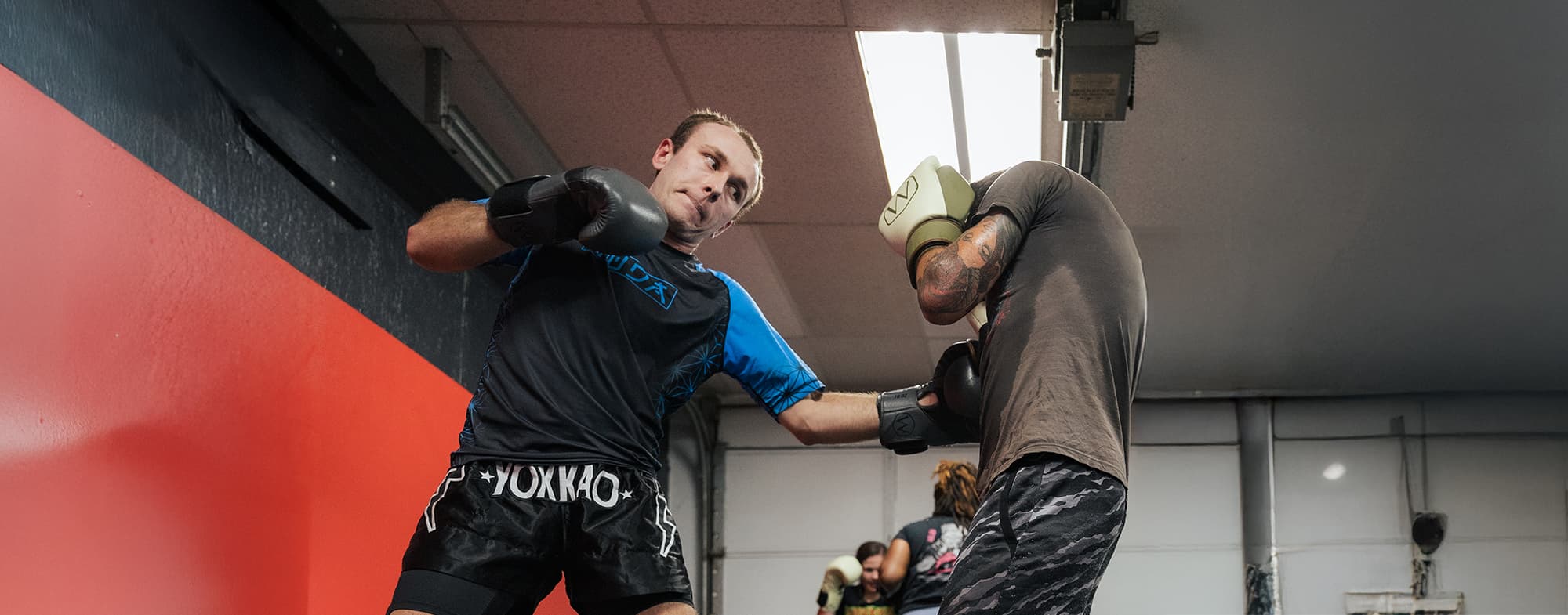
Inside the combined class, the coach scales technique to each student's track. During pad work, a Kickboxing-focused student might get called on combinations like "jab–cross–lead hook–rear roundhouse" while a Muay Thai-focused student gets "teep–cross–rear elbow–clinch entry." Both students are training off the same pads, with the same coach, in the same class. The session is built to handle that.
For first-day students, the coach defaults to the more accessible toolkit (basic Kickboxing combinations) and only layers in Muay Thai-specific work once defensive habits are solid. There is no rush to introduce clinch on day one, beginners need balance, footwork, and combinations first.
When you might want to specialize
If you eventually want to compete in pure Muay Thai or pure Kickboxing, the coach can prep you for that specifically. Camp work for a sanctioned amateur fight is different from regular class, sparring volume increases, conditioning is sport-specific, and rules-restricted drilling takes over. We have done both kinds of camps. Specialization happens inside the same room; you do not need to leave the program to compete.
What this means for cost
The Striking Only membership covers all classes in our combined striking session. There is no separate "Muay Thai upgrade" tier, no extra fee for clinch work, and no double-billing for students who want to train both traditions. The All-Inclusive and Premier tiers add grappling and MMA on top.
Ready to try a class?
The fastest way to understand the combined model is to see it. Book a consultation and we will walk you through the room before your first session. Whether you came in for Kickboxing, for Muay Thai, or just for "striking," the class will meet you where you are.
Warrior Fitness Center
Ready to train with Warrior Fitness Center?
Book a consultation, tour the gym, and find the right class to start your first week.
Keep Reading
Striking
Muay Thai vs Kickboxing: What's the Difference?
A practical breakdown of Muay Thai and kickboxing for beginners deciding how to start striking training in Colorado Springs.
Read ArticleBlog
The Room Is Always Teaching
How training partners, status, tolerated behavior, and coach reactions shape the real culture of a BJJ, Muay Thai, or MMA gym.
Read ArticleBlog
Your Training Partners Are the Product
A martial arts membership buys more than instruction. It buys access to a room of people who can sharpen your skill, waste your time, or get you hurt.
Read Article